
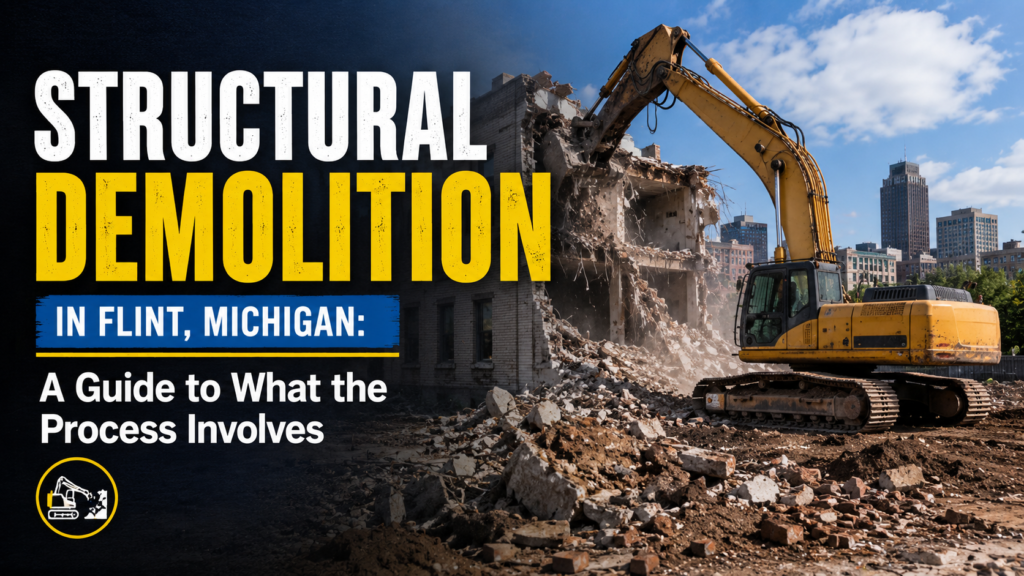
Structural demolition is one of the most consequential and technically demanding services in the construction and redevelopment industry. In Flint, Michigan a city that has been actively working to remove deteriorated and blighted structures as part of its ongoing urban renewal structural demolition is a frequent, regulated, and community-significant activity. Understanding what Structural Demolition Flint involves, how it is planned and executed, and what happens to the site after a structure comes down helps property owners, developers, and community stakeholders approach these projects with realistic expectations and appropriate preparation.
What Is Structural Demolition?
Structural demolition refers to the planned, engineered removal of a building or structure in part or in whole. It is distinct from interior demolition (which removes finishes and non-structural elements within a standing building) and from simple clearance work. Structural demolition involves bringing down load-bearing systems walls, columns, beams, foundations, and floors that support the building’s form. Because these elements are interconnected and under load, their removal requires systematic planning to ensure the demolition sequence does not cause uncontrolled collapse, damage to adjacent structures, or injury to workers.
In Flint, structural demolition encompasses a wide range of project types: the removal of deteriorated residential homes, commercial buildings past their service life, abandoned industrial structures, old foundations left after partial demolition, and institutional buildings being cleared for redevelopment. Each type has its own structural characteristics and demolition requirements.
Pre-Demolition Planning: The Phase That Determines Everything
The physical act of demolition is often the shortest phase of a structural demolition project. The pre-demolition planning phase which determines how the structure will come down, in what sequence, with what equipment, and under what safety conditions is where the technical expertise of the demolition contractor is most critical.
Pre-demolition planning in Flint includes:
- Structural assessment: Engineers or experienced demolition estimators evaluate the building’s construction type, materials, condition, and the presence of any non-standard structural configurations that affect the demolition approach.
- Hazardous materials survey: Buildings constructed before the 1980s which represent a significant portion of Flint’s building stock frequently contain asbestos in insulation, floor tiles, ceiling materials, and roofing. Lead-based paint is also common. A licensed inspector must survey for regulated materials before any demolition begins. Under federal AHERA requirements, workers and supervisors dealing with asbestos-containing materials in commercial buildings must be EPA-certified.
- Utility disconnection: All services gas, electricity, water, sewer, and telecommunications must be formally disconnected and confirmed by the respective utility companies before structural demolition begins.
- Permitting: The City of Flint and Genesee County require demolition permits. For properties involved in Michigan’s blight elimination programs, coordination with program administrators is also required.
Methods of Structural Demolition
The demolition method selected for any given structure depends on its size, construction type, location relative to adjacent structures, and the planned use of the site after demolition.
- Mechanical demolition: The most common method in Flint. Excavators equipped with hydraulic shears, breaker attachments, or standard buckets systematically dismantle the structure. The demolition sequence typically begins from the roof and works downward. Mechanical demolition is precise enough to work in urban environments with adjacent occupied structures.
- Selective demolition: Used when specific portions of a structure are to be retained or when salvageable materials are being recovered. This method is slower and more labor-intensive but can recover significant quantities of reusable steel, brick, and timber.
- High-reach demolition: For taller structures in Flint industrial buildings, multi-story commercial or institutional structures high-reach excavators with extended arms allow controlled demolition at heights that standard equipment cannot reach safely.
- Explosive demolition (implosion): Reserved for large structures where geometry and site conditions allow the use of strategically placed explosive charges to collapse the structure inward. Due to the urban density of most Flint demolition sites, this method is rarely applicable.
Hazardous Material Abatement: A Non-Negotiable Pre-Demolition Step
Asbestos and lead paint abatement are legally required to be completed before structural demolition begins on any building where these materials are identified. The regulatory framework covering commercial and large residential demolitions is comprehensive and enforced at both state and federal levels.
Abatement involves the identification, containment, removal, packaging, and disposal of regulated materials by licensed contractors following EPA-specified protocols. The scope and complexity of abatement work on older Flint buildings can be substantial asbestos was used pervasively in building materials through the 1970s, and many Flint structures date to the early and mid-twentieth century when asbestos use was at its peak.
Lead-based paint on exterior surfaces presents additional considerations for structural demolition in Flint, where soil contamination from paint debris is a recognized public health concern. Proper containment during demolition and appropriate clean-up of the site after work is complete are essential components of responsible structural demolition practice.
Debris Management and Material Recovery
A typical structural demolition generates substantial quantities of debris concrete, masonry, steel, wood framing, glass, and other building materials. Responsible demolition contractors in Flint manage this material systematically:
- Steel and ferrous metals are the most economically valuable recovered materials and are routinely sorted and recycled.
- Concrete is broken up and can be processed into recycled aggregate for use as base fill material in road and site construction.
- Wood framing from older structures may have salvage value depending on species, dimension, and condition.
- Remaining mixed debris is loaded and hauled to permitted disposal facilities.
Material recovery during demolition reduces disposal costs, generates material credit, and supports the sustainability of the demolition process by diverting reusable material from landfill.
Site Restoration After Structural Demolition
Once the structure is demolished and debris removed, the site requires appropriate restoration to make it safe and suitable for its next use. This typically involves removal or burial of the existing foundation (if it was not addressed during demolition), backfilling any excavated areas with clean compacted fill, rough grading to establish positive drainage, and application of topsoil and erosion control seeding to stabilize the surface until the next development phase begins.
In Flint’s urban redevelopment context, post-demolition site restoration is a community responsibility as well as a property obligation. A properly restored, graded, and stabilized former demolition site is a neighborhood asset. An improperly finished site with unstable backfill, exposed foundation remnants, or uncontrolled erosion creates ongoing hazards and maintenance burdens for the surrounding community.
Conclusion
Structural demolition in Flint is a skilled, regulated, and community-impactful activity that goes far beyond simply bringing a building down. The planning, hazardous material management, execution, and site restoration that surround the physical demolition work are what determine whether a project is truly successful not just as an engineering operation, but as a contribution to the health, safety, and revitalization of Flint’s neighborhoods.